Four Skills That Make or Break Your Relationships
September 30, 2026

There are four skills that determine how well your relationships work. Not communication techniques or conflict resolution strategies — something more basic than that. Four directional movements that happen between people, constantly, in every relationship you have.
Most people are naturally good at one or two of them. Most people also have one or two that they find very difficult. The pattern of which skills come easily and which don't shapes your friendships, your marriage, your family relationships, and your work life. It shapes how you parent. It shapes how you show up in a group.
I learned about these four skills from my colleague Ryan Spencer, a licensed marriage and family therapist, certified group psychotherapist, and Fellow of the American Group Psychotherapy Association who practices in Austin, Texas. Ryan describes these movements as part of how people regulate closeness and distance in relationships — what is called the "contact function". After hearing him lay out these four skills, I studied the pattern and noticed that they fit into a two-by-two matrix that makes the pattern clear.
The Four Skills
Think of your relationships as having two dimensions: direction (toward or away) and who moves (you or the other person). That gives you four skills:
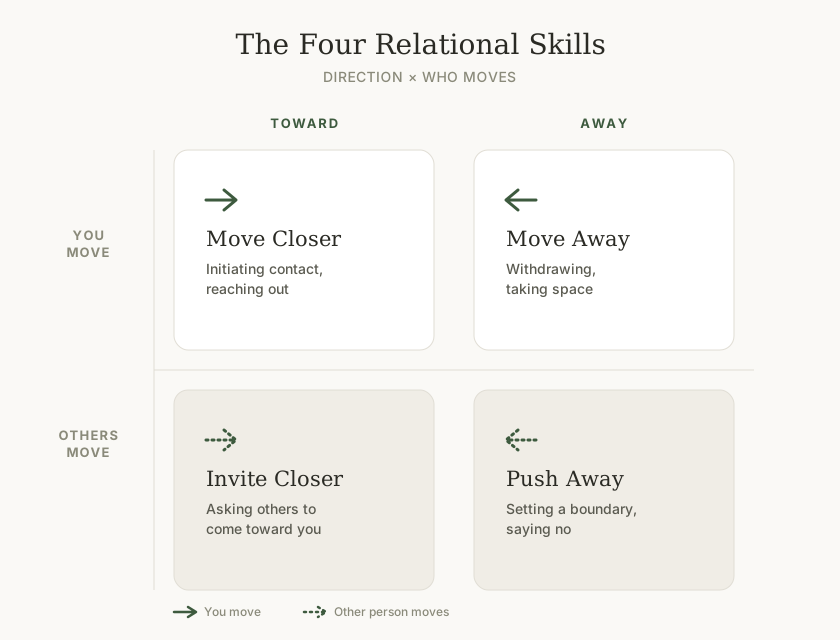
1. Moving Closer to Others
This is the ability to move closer to others — to initiate contact, to approach someone, to reach out, to take the first step. It looks like sharing something about yourself, starting a conversation, telling someone you care about them, letting someone know you are interested in them. It doesn't have to be romantic or sexual — it can be platonic interest or attraction, too.
People who are good at this tend to be seen as warm, outgoing, or brave. People who struggle with it may want connection deeply but wait for it to come to them, sometimes indefinitely. This is often what people mean when they talk about a fear of intimacy — not a lack of desire for closeness, but a fear of what closeness might cost them.
2. Inviting Others to Come Closer
This is different from approaching. Here, you're not moving toward someone — you're asking them to move toward you. It's the ability to say, "I want you to come closer to me". To ask someone to come closer, to ask them to share things about themselves with you, to let them know you want them. To make a request or ask them to help you in the relationship rather than doing all the work yourself.
This one is hard for people who are used to doing all of the work in the relationship themselves, or who are afraid that others are not interested in them. People who have a hard time with this may have learned early that their needs wouldn't be met, or feel that asking for something means being a burden. They can go toward others all day long — but they can't ask others to come toward them.
3. Moving Away from Others
This is the ability to withdraw — to step back, to take space, to be alone when you need to be. It looks like leaving a conversation that isn't good for you, spending time by yourself without guilt, choosing not to engage.
People who struggle with this may feel trapped in relationships, overwhelmed by other people's needs, or unable to take a break without feeling like they're abandoning someone. They stay when they should go, and they lose themselves in the process. They may also feel that they need to suffer in a relationship as a way of loving or holding space for the other. This pattern is sometimes called codependency — losing yourself in someone else's needs and mistaking the suffering for love.
4. Pushing Others Away
This is the ability to set a boundary — to say no, to tell someone to stop, to ask someone to leave, to hold your ground when someone is coming too close. It's different from withdrawing. When you withdraw, you move. When you push, the other person moves.
This is often the hardest skill for people who were raised to be agreeable, to keep the peace, to not make waves — the pattern often called people pleasing. It's really a boundaries problem: the inability to say no. They can pull away quietly, but they can't look someone in the eye and say, "No. That's enough. You need to back up".
Why You Need All Four
If you can move toward people but can't push them away, you'll end up in relationships where you give everything and protect nothing.
If you can push people away but can't invite them closer, you'll be safe but alone.
If you can withdraw but can't approach, you'll spend your life waiting.
If you can approach but can't withdraw, you'll lose yourself in other people.
People who can do all four are able to have healthy connection and healthy autonomy and individuation, both at once.
The people who do well in relationships — who sustain real intimacy, navigate conflict, maintain their identity while staying connected — can do all four. They can get close. They can ask for closeness. They can step back. And they can tell someone else to step back.
That doesn't mean all four are easy. It means all four are available.
Where Group Therapy Comes In
A therapy group is one of the few places where you can actually practice all four of these skills with real people, in real time, with support.
In everyday life, the stakes are high. If you push someone away at work, you might lose the relationship. If you try to get closer to someone at a party and it goes badly, you carry the embarrassment. The social consequences are real, and they keep most people stuck in their one or two comfortable skills.
In a group, the environment is different. There's a group agreement. There's a therapist paying attention. And there are other people in the room who are working on the same things — some of whom are strong where you are weak, and weak where you are strong.
A person who has never pushed anyone away in their life can try it in group and discover that no one dies. A person who has never asked for help can make the request and feel what it's like when someone actually responds. A person who always approaches can practice sitting back and letting someone come to them. A person who always withdraws can practice staying.
The group doesn't just talk about these skills. It activates them. The interpersonal patterns that cause difficulty in life show up in the room, and the group becomes the place where you work on them — not by analyzing them, but by trying something different, right there, with people who can see you.
This is true for adults, for teens, and for therapists in training groups. The skills are the same. The practice is the same. The group is where it happens.
Which Skills Are Yours?
Think about your closest relationships. Which of these four movements comes easily to you? Which one makes you uncomfortable just reading about it?
Most people can answer that quickly. The skill that made you flinch is probably the one you need most. And the good news is that these are skills — not personality traits. They can be learned. They can be practiced. And they can change how every relationship in your life works.
If you're curious about working on this, a free consultation call is a good place to start.
The four relational skills described in this post were articulated by Ryan Spencer, LMFT, CGP, a certified group psychotherapist and Fellow of the American Group Psychotherapy Association, as part of his work on the contact function in modern analytic group therapy. The 2×2 matrix organizing these skills was developed by Paul Callister.
Paul Callister, PhD, CMHC, CGP is a licensed clinical mental health counselor and certified group psychotherapist. He founded the Utah Group Therapy Center to offer interpersonal process groups in Utah.